Aphotic is an encrypted messenger for Android that works without a phone number, an account or your name. Every message travels over Tor, which hides your IP address from us as well as from everyone else. The encryption is already built to hold up against quantum computers.
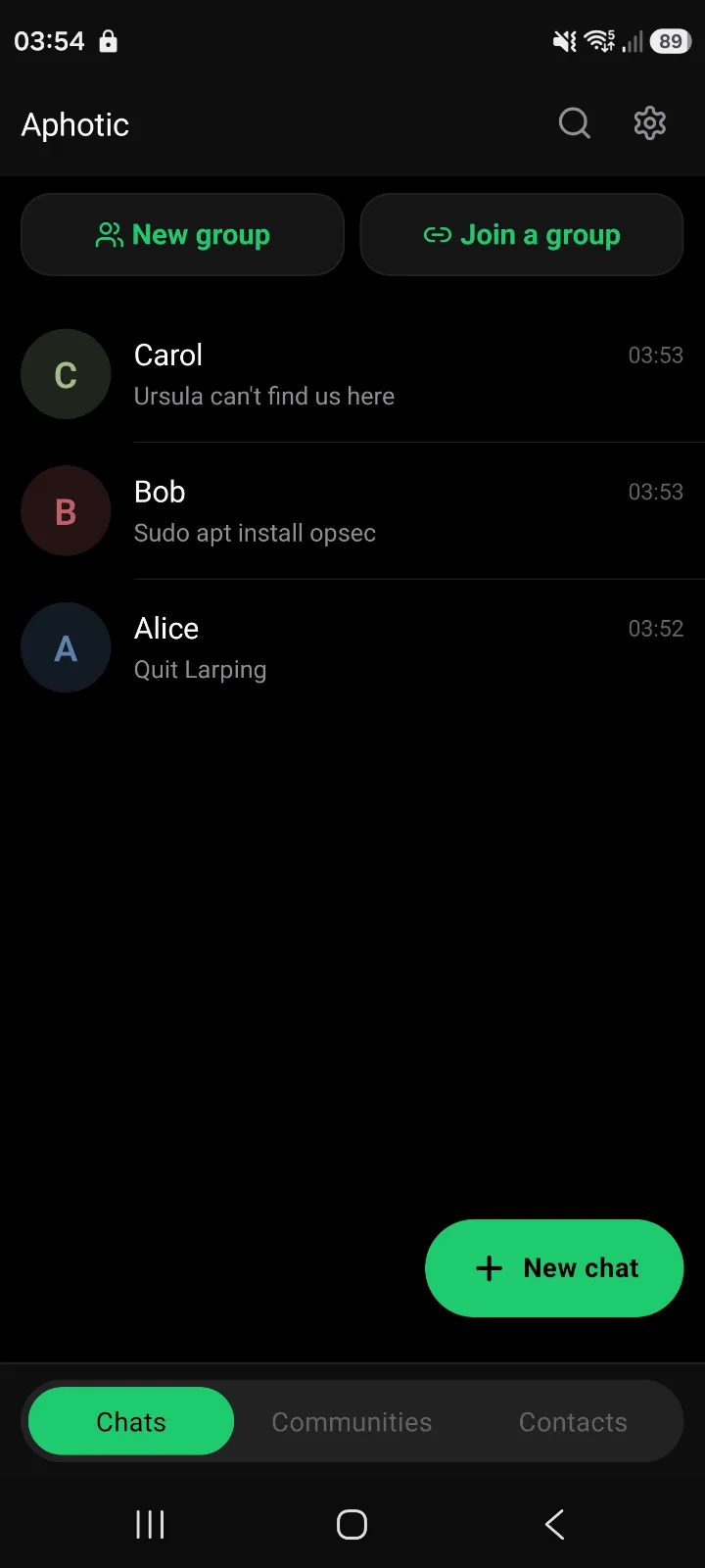
Aphotic
- personal details we ask for
- 0
- message encryption, plus post-quantum key exchange
- AES-256
- at most in the queue for each copy of a message
- 7 days
- pay without a card or bank account
- Monero / Bitcoin
personal details we ask for
message encryption, plus post-quantum key exchange
at most in the queue for each copy of a message
pay without a card or bank account
Your device does the crypto. The relay only ever moves ciphertext.
Every feature below exists to stop some piece of information about you from ever being created.
Sealed sender by default
A direct text message arrives with nothing on the outside saying who sent it, so the server cannot read the sender off it. The technical name for this is sealed sender.
Messages run only over Tor
There's no public web address to attack or watch. Tor comes built into the app, so there's nothing extra to install, and neither you nor the person you're writing to ever learns the other's IP address.
Disappearing messages
Pick a timer between 30 seconds and 7 days. The timer is sealed inside the encryption along with the message, so the server never learns that you set one.
No phone number or account
You are an ID your phone works out from keys it makes itself, and you share it as a QR code. The app asks for no email address or real name and never touches your contact list.
Post-quantum key agreement
Someone can record your encrypted messages today and sit on them, hoping to crack them in twenty years with hardware nobody has built yet. Aphotic sets up every conversation with PQXDH, a hybrid X25519 + ML-KEM-1024 key exchange chosen to still hold when that day comes.
A vault with a panic PIN
Everything stored on your phone sits in an encrypted vault. Five wrong PINs erase it. A second PIN wipes everything at once, with no prompt and no warning.
The crypto code is on this site
The protocol page writes out every construction with its key sizes and its limits, and under most of them shows the function that implements it. The site build cuts those functions straight from the app and server source, and it fails when one is renamed or removed.
On our servers
What the server knows about you
The quickest test of a messenger is what its servers keep. The main items are below, and the transparency page lists every one.
The server stores
- 01An ID derived from your public keys, and those keys
- 02Scrambled message data: each copy 7 days at most in the queue, longer for a Community with saved history
- 03Proof that somebody paid, with nothing tying it to a person
The server never has
- Who sent a direct text message. Its envelope carries no sender.
- What you say. Only the scrambled version ever reaches us.
- A phone number, an email address or your contacts. We never ask for any of them.
- Your IP address or your location while you message. Messages run over Tor at both ends. A voice call is the exception: our call relay sees both IP addresses while the call runs.
- When you signed up or when you were last online. The database has no columns for either.
License keys are our only income
Aphotic is paid software. You buy a license key with Monero or Bitcoin, and those sales are how the operator earns money. There are no ads or trackers, since there is no data business here to feed.
No database of ours connects your payment to the identity you chat under, and the walkthrough further down shows why it can't. Someone running both services could try to pair the two by timing, which gets harder the more people use Aphotic.
Around 10,000 users per relay
The design is built for ten thousand. Past that you'd need a far more complicated setup and a team to keep it standing. Below it, the backend is two small programs that one person can read through in an afternoon, and that is why the limit exists. If you need more room, run a second relay.
- messages a second under load testing, 278,935 sent, zero errors
- 3,569
- or less for 99 in 100 sends at that rate
- 250 ms
- at most in the queue for each copy of a message
- 7 days
How is my payment kept apart from my chats?
You pay with crypto and get a license. The service that took your money should never find out who you chat as, and a trick called a blind signature makes sure the tokens themselves can't tell it. Think of signing your name across a sealed envelope: the signature is real, and the signer never saw what was inside. The steps below show what your phone does.
- 1
Pay with crypto, get a license key
You buy with Monero or Bitcoin, with no name, email address or account. All you walk away with is a 16-character license key. Most crypto payments appear on a public list of transactions; Monero payments don't.
no name · no email · no account
- 2
Your phone blinds a random token
Your phone invents a fresh random token and covers it with a secret of its own before anybody else sees it. The covered version looks like noise, and the token underneath stays hidden, like a letter in a sealed envelope.
token × secret cover
- 3
The licensing service signs it blind
The licensing service checks that your license is valid and signs the covered version without ever seeing the token underneath. It keeps a count of how many tokens it has signed and nothing of the tokens themselves.
checks license · counts · never reads
- 4
Your phone unwraps the signature
Your phone removes its secret. What's left is a real, valid signature on the real token, one the signer has never laid eyes on and cannot recognise if it sees it later.
uncover → valid signature
- 5
The chat server redeems it
You hand the uncovered token to the chat server. It checks the signature and lets you in for the next hour. It cannot link that token to your license or to your payment.
licensed for the hour · unlinkable
What the operator cannot look up
Even the operator, running both services with full read access to both databases, finds nothing there that connects the license you paid for to the identity you chat as. The blind signature means the link is never created, so there is none to store. What remains is timing: someone watching both services live could try to pair a license's requests with an identity's, most easily at the first sign-up right after a license is activated, and that gets harder the more people use Aphotic.
A small network that holds little
The system is small and hidden on purpose. The app reaches every chat server through Tor, none of them has a public address for anyone to attack, and adding servers never gives anyone something new to learn about you.
Your device
The only place your messages are ever readable. Your keys live here, inside an encrypted vault, and Tor runs inside the app, so there's nothing separate to install.
readable only here, nowhere else
The Tor network
Chatting, activating a license, updating the app: the app does every one of those over Tor. No chat server learns your IP address and you never learn a server's. The shop's website also has an ordinary web address, and you can reach it over Tor as well. Only the audio of a voice call leaves Tor, through a call relay of ours, and the app asks you first.
no IP addresses · both sides hidden
The main relay
The server we run. It's reachable only inside Tor and has no ports open to the internet at all. It passes your encrypted messages along, and it's also where licenses come from.
inside Tor only · nothing exposed
Operator relays
Anyone with an operator license can run their own server for their community, on hardware they control. Your ordinary license works on any of them, and you choose which one is your home. Friends on other relays are still one message away: your app posts straight to their relay.
independent relays · your license works anywhere
A directory you can verify
Your app finds servers through a list that the main relay signs, and the key that checks the signature is baked into the app. A fake or altered server cannot forge its way onto that list.
signed centrally · checked by the app
Getting access
You buy a license with Monero or Bitcoin, with no account and no email address, and no database links it to the identity you chat under. That's the sealed-envelope signing described in the section above.
crypto · no account · no stored link
Reaching people on other relays
Every account has a home relay, and you can message anyone on any relay. Your app posts each message straight to the recipient's home relay over Tor, sealed, so the envelope carries no sender for that relay to read. The relays themselves never connect to each other: your own relay never sees who you write to elsewhere, and nobody's messages pass through a server they didn't choose. Hidden senders, end-to-end encryption and central licensing work the same across every relay.
How the mesh works →What this network never learns
Tor covers both ends, so no server sees your IP address. Your messages are encrypted the whole way, so no server can read them either. Direct messages arrive with no sender on them, and your payment can't be tied to your chats. Adding servers adds capacity and choice and gives nobody anything new to learn about you.
One key, no account or email
Buy a license, install the app, type in the key.